

Top Signs You Need Air Duct Cleaning Service – Don’t Ignore These
Dust on your registers isn’t a sign your ducts need cleaning. It’s a sign your filter is already failing to catch what’s moving through your system, and cleaning without fixing that first just resets the problem for next season. Warning signs matter because each one points to a different mechanical failure inside your ductwork. Read them correctly and you’ll know what’s actually happening before anyone touches a register in your Tacoma home.
If you’d rather have trained eyes on it, call (877) 703-6064.
Key Takeaways
- Dust at registers usually means filtration failure, not dirty ducts alone.
- Uneven room temperatures point to restricted branch runs, not a weak furnace.
- A musty smell at startup can mean standing moisture upstream of the ducts.
- A filter that grays out in 2-3 weeks is a re-entrainment signal.
- Supply versus return debris tells you whether the problem is distribution or collection.
Uneven Room Temperatures: A Pressure Imbalance, Not a Weak Furnace
When one bedroom stays cold while the rest of the house is comfortable, most homeowners replace the thermostat or blame the furnace. Usually neither is the problem. Debris buildup restricts airflow in specific branch runs, not the whole system equally, so the duct feeding that room is carrying a fraction of the air it was designed for.
Think of your duct system as a tree. If one branch narrows, static pressure climbs behind the restriction and the furnace pushes more air down the paths of least resistance. The rooms closest to the plenum get warmer, the affected room gets colder, and the blower motor works harder doing it. In Tacoma homes with older galvanized trunk lines and long branch runs to upstairs bedrooms, this pattern shows up again and again.
What to check before assuming a duct problem:
- Confirm the register in the cold room actually delivers airflow. Hold a tissue to it while the system runs.
- Check that the damper on that branch (if there is one) is open.
- Replace the filter and see whether the imbalance changes.
- Note whether the room is cold year-round or only in heating season.
If the room stays cold after those checks, a technician can measure static pressure and airflow at the register to confirm whether debris or a disconnected run is the cause. That’s a diagnostic step, not a guess.
Musty Odor at HVAC Startup: What It Actually Indicates
That faint musty smell the first few minutes after the heat or AC kicks on isn’t just “dirty ducts.” Odor at startup is the system pushing air across a surface that has stayed damp, and the source is usually upstream of the ductwork itself: standing moisture in the plenum, a clogged condensate drain, or a drain pan that isn’t draining properly.
A small amount of dust burning off the heat exchanger at the start of heating season has a dry, dusty smell. A musty, earthy, wet-cardboard smell is different, and it doesn’t fade after a few minutes. That distinction matters because cleaning the ducts without addressing the moisture source will only buy you a few months before the smell returns.
Our technicians check for moisture at the coil and drain pan before any cleaning begins, because a wet plenum is a biological growth environment. When contamination is present, we use Abatement Technologies air filtration equipment, the same remediation-grade containment used in mold and hazardous-material work, so the cleaning happens in a controlled environment instead of spreading spores through the house.
If the smell is persistent and accompanied by visible moisture, treat it as a system problem to diagnose, not a duct to vacuum.
Winter Allergy Symptoms That Worsen When the House Seals Up
Allergy symptoms that get worse in winter, not better, are a Tacoma pattern worth understanding. Our mild, wet winters push homeowners to close windows and run the furnace more, which means the same air recirculates through the duct system under higher heating load for months at a time. Contaminants that sat relatively undisturbed in summer are now being cycled through every room several times a day.
Signs this is duct contamination rather than seasonal pollen:
- Symptoms improve when you leave the house and return within an hour of coming home.
- Congestion or sneezing is worse in specific rooms, especially bedrooms where doors stay closed.
- Symptoms track with furnace runtime, not with outdoor pollen counts.
- You notice more dust settling on surfaces after the heat has been running steadily.
If several of those line up, the next step is a filter diagnostic and an inspection of the return side of the system. Cleaning alone treats the symptoms. Sanitizing after cleaning is the step that makes the result last, and we treat it as part of the job, not an add-on.
The Filter-Change Interval Diagnostic
A fresh filter that turns visibly gray within two to three weeks is telling you something specific: particulate is re-entering the airstream from duct surfaces, not just arriving from living space. A filter working against normal household dust should hold color for a month or more in most homes. When it loads that fast, the duct interior is acting as a reservoir that keeps feeding the filter.
This matters because it’s the most objective sign on the list. You don’t need a meter or a technician to read it. Buy a filter, write the install date on the frame edge with a pencil, and check it at two weeks.
What the results mean:
- Still clean at 30 days: filtration is working. No action needed beyond normal replacement.
- Noticeably gray at 2-3 weeks: duct surfaces are shedding particulate back into the system.
- Gray in under a week: check for a return-side leak or a disconnected run pulling air from a crawlspace or attic.
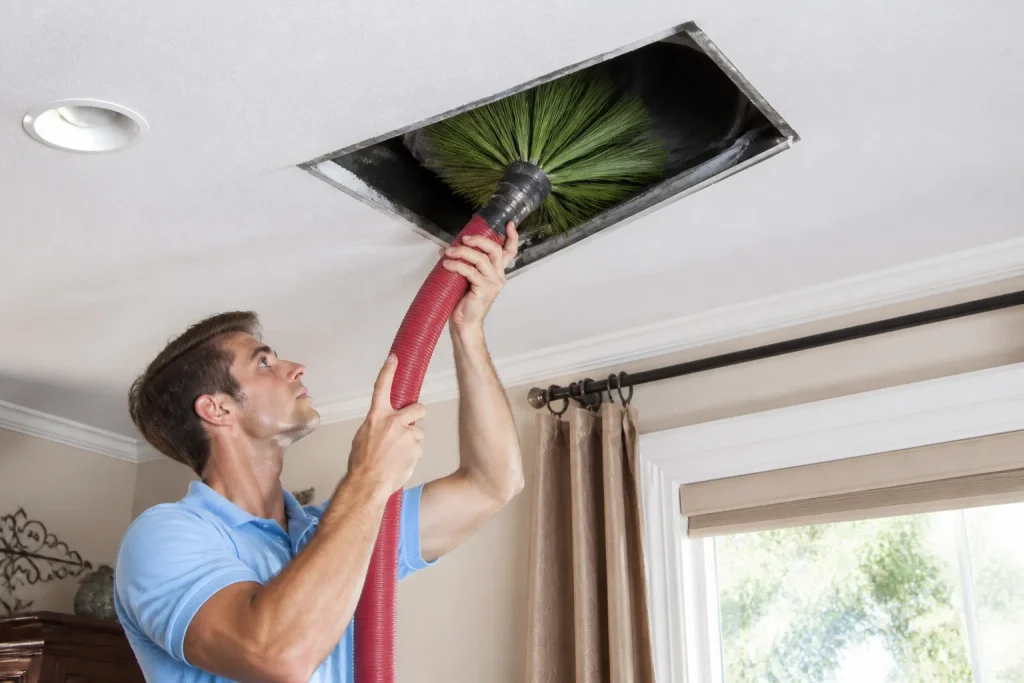
We use Rotobrush and Nikro mechanical agitation and extraction systems for this reason. They contact the duct surfaces directly and pull the loosened material out under negative pressure, which is what actually reduces the reservoir a filter is fighting. A shop vac and a brush on a cord won’t reach the whole run.
Supply vs. Return Registers: Two Different Signals
Debris at a supply register and debris at a return register tell different stories, and knowing which is which helps you describe the problem accurately before a technician arrives. Supply registers are the delivery end. Return registers are where air comes back to the system.
Debris at supply registers usually means material is being deposited as air leaves the duct. That points to contamination inside the branch runs downstream of the plenum, or to a leak drawing unfiltered air into the run before it reaches the room.
Debris at return registers points to the return side doing too much work. A return that’s pulling from an open cavity, a poorly sealed joist bay, or a garage wall is drawing in whatever lives there. In Tacoma homes with older construction, unsealed return chases are common and often invisible from inside the house.
Walk the house with a flashlight and note which registers show buildup, then look for gaps where the boot meets the floor or wall. Duct leaks don’t fix themselves, and cleaning without sealing closes the surface symptom but leaves the entry point open. That’s why we offer repair and sealing alongside cleaning, so the root cause gets addressed in the same visit.
When to Call a Pro
Some of this you can check yourself: filter timing, temperature differences, a tissue at the register. Call a professional when any of these are true:
- The filter grays out in under two weeks despite a correct filter fit.
- You smell mustiness at startup that doesn’t fade.
- One or more rooms stay cold regardless of damper position.
- You see loose debris, visible gaps, or disconnected flex duct at a register or in the attic.
- Allergy symptoms concentrate at home and improve away from it.
Our technicians have up to 13 years of experience reading these signals, and they carry the equipment to confirm what the symptoms mean. Call (877) 703-6064. We answer 24/7. Fast dispatch from 7am to 7pm, Sunday through Friday.
Related services in Tacoma: air duct cleaning, HVAC cleaning, and dryer vent cleaning. For a full look at what we do, see our Tacoma Air Duct Cleaning Experts home page.
The Bottom Line
Dust on the register is the sign most people notice, and it’s usually the least useful one. The signals that actually matter are mechanical: a filter loading faster than it should, a branch run choking off airflow to one room, a musty smell pointing to moisture upstream, and winter symptoms that track with furnace runtime instead of pollen season. Read together, they tell you whether you’re dealing with a surface issue or a system one.
One last thing, offered in the spirit of full disclosure: if you’ve ever cleaned a register with a vacuum and felt accomplished, you’re not alone. But that register is the last 4 inches of a run that could be 30 feet long.
If you’re in Tacoma and need help, Tacoma Air Duct Cleaning Experts offers free estimates. Call (877) 703-6064. We answer 24/7. Fast dispatch from 7am to 7pm, Sunday through Friday. One flat price per system, agreed before work starts, with before-and-after photos of your own ducts.
Frequently Asked Questions
Look for mechanical signals, not surface dust: a filter that grays out in 2-3 weeks, one room that stays cold despite an open damper, a musty smell at HVAC startup, or visible debris at return registers. Any two of those together justify an inspection. Call (877) 703-6064 for a free estimate.
Most Tacoma homes don’t need a fixed interval. Clean when the signs point to it: after a remodel, a moisture event, a pest issue, or when the filter diagnostic shows fast loading. Homes with pets, smokers, or heavy winter furnace use tend to hit those signs sooner. Call (877) 703-6064 for an honest assessment rather than a schedule.
Cheap quotes usually cover a surface vacuum of the visible registers, not the full run. A proper job agitates the duct interior with equipment like Rotobrush or Nikro systems and extracts under negative pressure, which takes longer and costs more. We quote one flat price per system before work starts, so the number you agree to is the number you pay. Call (877) 703-6064 for an exact quote.
Ask for before-and-after photos of your own ducts, not stock images. A crew that uses containment and extraction equipment can show you what came out and what the interior looks like afterward. We provide both as part of the job. Call (877) 703-6064 to schedule.
Written by the team at Tacoma Air Duct Cleaning Experts.
Need Air Duct Cleaning Help?
Call Tacoma Air Duct Cleaning Experts - the local pro we connect you with is licensed and insured, with free written estimates in Tacoma.
(877) 703-6064