
Emergency Air Duct Cleaning Near Me: What Tacoma Homeowners Should Do First
If smoke, sewage smell, or visible mold just pushed you to search “emergency air duct cleaning,” the ducts themselves may be the last thing you should clean right now. In most Tacoma homes, the first correct move is to shut the system down and figure out what you’re actually dealing with. Most “emergency” duct calls we hear about are really triage calls: the system needs to be diagnosed before it’s cleaned. If you’d rather have a trained set of eyes on it than sort it out yourself, call (877) 703-6064. We answer 24/7. Fast dispatch from 7am to 7pm, Sunday through Friday.
Key Takeaways
- Turn the HVAC system off before you call anyone. Running it spreads contamination through every room.
- Identify whether the ducts are the source of the problem or just the carrier. Fire residue, an HVAC fault, and moisture intrusion each need a different response.
- Mold in a wet-climate home like Tacoma needs sanitizing with EPA-registered antimicrobials, not just vacuuming.
- Photograph registers and the filter before anyone touches the system. It matters for insurance and for verifying the work.
- Ask three specific questions on the phone to filter out crews who aren’t set up for contamination scenarios.
Is it actually an emergency? How to tell in the first ten minutes
An air duct emergency in Tacoma is any situation where contamination is actively moving through your home or your family is breathing something harmful. That’s the test. Not “the ducts look dirty” and not “the house smells a little musty.” Active spread is the line.
Here’s the fast triage we’d walk you through on the phone:
- Shut the HVAC system off at the thermostat. Not to fan-only, not to “circulate.” Fully off. Every minute it runs, it pushes whatever is in the ducts into every room in the house.
- Locate the smell or source. Is it acrid and smoky, or damp and earthy? Smoke points toward fire residue or an electrical issue. Earthy and damp points toward moisture and mold. A sewage smell often traces to a dry trap or a plumbing problem, not the ducts at all.
- Look at the filter. A filter coated in soot, fuzz, or dark speckled growth tells you a lot in five seconds.
- Check for water. Staining near registers, condensation on duct runs, or a damp crawlspace points to moisture intrusion.
- Call for triage, not a cleaning ticket. Tell whoever answers exactly what you’ve observed and ask whether that changes what they’d bring and how they’d scope the job.
This is why same-day cleaning isn’t always the answer. Same-day triage is. Sometimes the right next step is a cleaning; sometimes it’s a repair, a moisture fix, or an HVAC diagnostic first.
Is the duct system the source, or just the carrier?
This distinction decides everything. If the ducts are the source, cleaning solves the problem. If the ducts are the carrier, cleaning buys you a few weeks and then the contamination comes right back. Here’s how to tell them apart:
- Fire residue. Soot and smoke smell that intensifies when the system runs, dark staining at registers, and a charred or acrid odor. The ducts are carrying residue from a fire or a smoldering electrical fault. The source problem needs to be resolved first, then the system is cleaned.
- HVAC unit fault. A burning smell that started suddenly and tracks with the system cycling on is often a blower motor, a belt, or a wiring issue. Cleaning the ducts won’t fix a failing component.
- Moisture intrusion. Mold growth, musty odor, and condensation mean water is getting in somewhere. Clean and sanitize the ducts, but you also need to find and close the water source. In Tacoma’s wet climate, this is the most common scenario we hear about. Rain-heavy months push moisture into crawlspaces and attic runs, and ductwork in those spaces acts like a sponge for humid air.
If you can’t tell which scenario you’re in, say so on the phone. A crew that’s set up for real contamination work will ask follow-up questions. A crew that quotes a price before asking a single question is telling you something.
What to tell a duct cleaning company over the phone
When you call, be specific. Vague calls get vague bookings. Here’s what to say and what to listen for:
- Say: “I smell smoke and the system is off.” or “I see dark speckled growth near a register and there’s condensation on the duct.” Describe the smell and what you’ve seen.
- Ask: “Do you carry EPA-registered antimicrobials for sanitizing?” A crew set up for mold scenarios should answer this directly.
- Ask: “What containment do you use while you work?” You want to hear about filtration equipment like Abatement Technologies units, the same remediation-grade gear used in mold and hazardous-material containment. That’s how you keep contamination from drifting through the house while it’s being removed.
- Ask: “Do you also do duct repair and sealing?” Loose joints and gaps are how contamination enters. A crew that only vacuums will leave the entry points open.
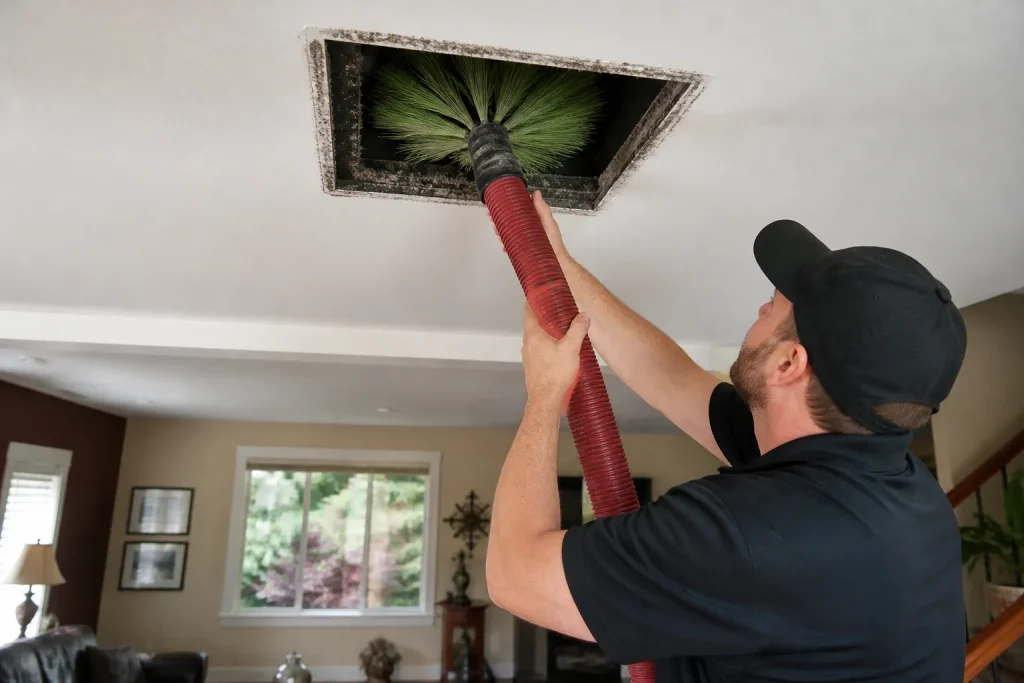
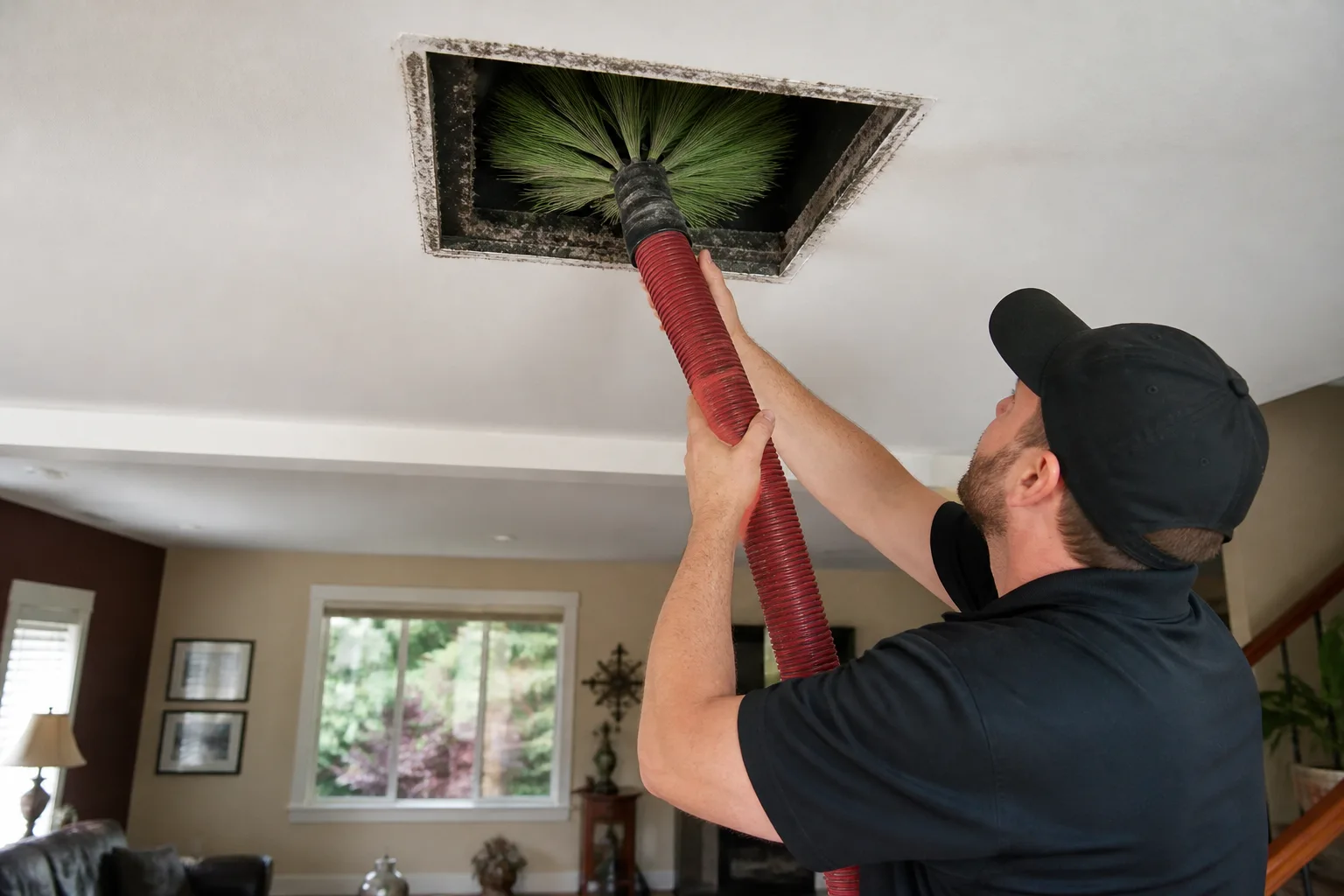
- Ask: “What equipment do you run?” Rotobrush and Nikro systems are the industry standard for mechanical agitation and extraction. If the answer is a shop vac and a hose, keep calling.
If a company can’t answer these without checking with someone else, that’s useful information too. The right crew will also want to know the layout of your home and whether you have pets, recent water damage, or anyone in the household with respiratory sensitivities.
Why Tacoma’s wet climate changes the mold protocol
Mold in a Tacoma home is a moisture story first. Our wet climate keeps crawlspaces, attics, and exterior duct runs damp for months at a time. When ducts sit in humid air, mold spores find a foothold fast. Vacuuming alone doesn’t fix that. It removes visible growth and knocks down the load, but the spores and the moisture that feed them stay behind.
That’s why the protocol for a mold scenario looks different:
- Contain the work area with filtration equipment so spores don’t spread.
- Clean mechanically with professional equipment.
- Sanitize with an EPA-registered antimicrobial that’s rated for HVAC surfaces.
- Find and address the moisture source, whether that’s a disconnected duct, a damp crawlspace, or poor attic ventilation.
- Seal gaps and joints so the problem doesn’t come right back.
Sanitizing isn’t an upsell in this climate. It’s the step that makes the cleaning hold. We also work with Honeywell and Aprilaire systems, so if you already have whole-home filtration or humidity control, we can evaluate it while we’re there rather than guess at what’s installed.
The documentation step most homeowners skip
Before anyone touches the system, take photos. It takes five minutes and it protects you in two ways. First, it gives your insurer a clear before-and-after record if a fire, water event, or storm is involved. Second, it lets you verify the work was actually done afterward. This is the step that separates a confident homeowner from one who’s wondering if the crew did anything at all.
What to photograph:
- Every register and return grille, from a distance and close up.
- The filter, in place, before removal.
- Any visible staining, growth, condensation, or debris near duct runs.
- The air handler and any equipment labels.
- Any water staining on ceilings, walls, or floors near the system.
Timestamp your photos. If you’re filing a claim, a dated record of the system’s condition before service is far more useful than a verbal description later. Any reputable crew should also be able to show you before-and-after images of your own system when they finish, so ask for that up front.
When to call a pro
If any of these are true, stop reading and call:
- You smell smoke, sewage, or a strong chemical odor that tracks with the system.
- You see visible mold growth on or near registers, or dark speckled staining on the filter.
- Anyone in the home has asthma, allergies, or another respiratory condition that’s suddenly worse indoors.
- There’s water staining, condensation, or a damp crawlspace feeding the ducts.
- You can’t tell what the problem is and don’t want to guess.
Call (877) 703-6064. We answer 24/7. Fast dispatch from 7am to 7pm, Sunday through Friday. During the call we’ll help you sort out whether it’s a cleaning, a repair, or an HVAC diagnostic that’s needed first. Our technicians have up to 13 years of experience, and we carry the equipment to handle the whole chain in one visit: cleaning, repair and sealing, and sanitizing. No panic booking required.
Related services in Tacoma: if the diagnosis points toward a standard cleaning rather than a contamination scenario, start with air duct cleaning. If you also want the rest of the system handled at the same time, that falls under HVAC cleaning. And if your dryer vent hasn’t been opened in a while, dryer vent cleaning is a fire-safety service worth adding. For the wider overview, see Tacoma Air Duct Cleaning Experts.
The Bottom Line
Most emergency duct calls are really triage calls. Shut the system off, figure out whether the ducts are the source or the carrier, photograph everything, and ask the right questions before you book. That order protects your air, your documentation, and your wallet. If you’re in Tacoma and need help, Tacoma Air Duct Cleaning Experts offers free estimates. Call (877) 703-6064. We answer 24/7. Fast dispatch from 7am to 7pm, Sunday through Friday. Estimates are free and the price is set per job by the written estimate, agreed before work starts.
Frequently Asked Questions
Yes. Turn the system fully off at the thermostat before anyone arrives and keep it off until the crew confirms it’s safe to run. Running it spreads contamination into every room, which defeats the purpose of the cleaning.
Look at whether the odor tracks with the system cycling and where the residue shows up. Smoke smell and soot at the registers points to duct-borne residue; a sudden burning smell that started without any fire history often points to a blower motor, belt, or wiring issue. When you can’t tell, a technician can diagnose it before any cleaning begins.
Our pricing is set per system by a free written estimate, agreed before work starts, with no per-vent pricing and before-and-after photos of your own ducts on request. Call (877) 703-6064 for an exact quote. Estimates are free.
Cheap quotes usually skip containment, sanitizing, and repair work, and some run shop vacs rather than professional equipment. That’s often how a low price becomes a much larger invoice once the crew is on site. One flat price per system, agreed before work starts, is the answer.
Written by the team at Tacoma Air Duct Cleaning Experts.
Need Air Duct Cleaning Help?
Call Tacoma Air Duct Cleaning Experts - the local pro we connect you with is licensed and insured, with free written estimates in Tacoma.
(877) 703-6064